




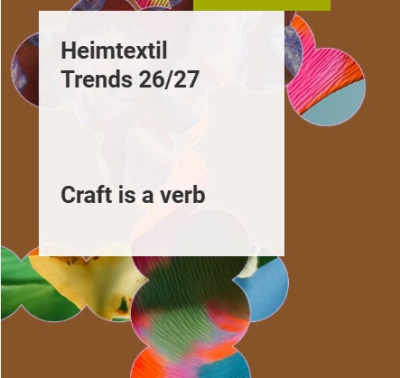
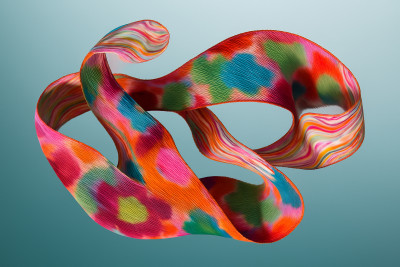
This approach expands in Heimtextil Trends 26/27, developed in collaboration with Alcova Milano, where the focus is not on fixed styles but on actionable directions for design, industry, and interior architecture. The trend identifies a convergence between artisanal practices and digital tools, including artificial intelligence, not as a replacement for technical knowledge, but as an extension of the creative process.
Textiles are thus presented as the result of a visible chain of decisions: thread structure, fabric reading, controlled irregularities, density, and light response. Against standardization, solutions where the process is integral to the product language and conveys material information within the space are prioritized.
The strategic directions defined by Heimtextil 26/27 describe a scenario in which technique becomes content. Practices combining hand-drawn elements with digital translations, algorithmically generated patterns applied to jacquard fabrics or embroidery, and structures where manual finishing coexists with automated processes are identified.
Nature is reinterpreted from a structural rather than figurative logic, translating rhythms, repetitions, and irregularities into fabric construction. At the same time, controlled imperfections, visible seams, and uneven dyeing are normalized as deliberate technical decisions.
These directions do not function as decorative trends but as development criteria applicable both to products and their specification in residential, contract, and large-scale projects.
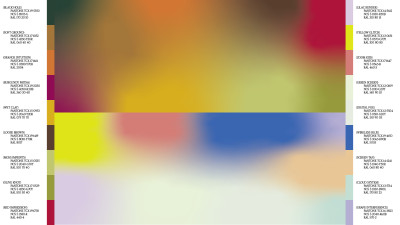
The color research associated with Heimtextil and Alcova Milano consolidates a palette designed to complement the material complexity of textiles. Neutral tones with an organic base—off-whites, sands, and mineral grays—serve as a foundation for visible structures and tactile surfaces.
This base is occasionally interrupted by color accents derived from natural pigments or controlled synthetic references, acting as spatial modulators rather than dominant elements. Color is understood as a tool for articulation, not decoration, reinforcing fabric reading and its production process.
Equipo DRT’s new collections operate within this conceptual framework, applying principles of materiality, structure, and suitability for use.
Eneas follows a logic of structural weave and artisanal finishing, where thread reading and material density provide visual stability. Its use in curtains responds to projects requiring material presence without relying on additional decorative elements.
Scala emphasizes the value of linen applied to upholstery, highlighting thread irregularity and offering solutions in velvet where the pattern integrates with the spatial architecture. The fabric’s technical precision allows use in both residential and contract environments.
Maly focuses on the relationship between natural materials, drape, and light effects. The fabric structure generates dynamic reading without altering visual continuity, facilitating application in large-format curtains and projects where light management is a priority.
Tibet features greater density and volume, designed for curtains and projects that concentrate materiality along wool lines. Its construction follows the “Craft is a verb” logic, where the textile communicates process, weight, and function through its own structure.
The convergence of Heimtextil trends, Alcova Milano’s color research, and Equipo DRT collections reflects a shift in contemporary textile design. Fabric is no longer a complementary element but a project tool capable of defining space, function, and material narrative.
For interior designers and professional specifiers, this scenario provides clear selection criteria based on process, structure, and application, enabling projects to be developed with technical coherence and continuity over time.
+credit photos: Heimtextil
+ info
https://heimtextil.messefrankfurt.com/frankfurt/en/programme-events/trends.html



 Whatsapp

 Back to blog
 Back
Back